
‘a better way’ – Une version repensée pour identifier plus facilement les exposants engagés
‘a better way’ provides a shared framework to help you better identify your suppliers’ responsible practices. Structured around five key areas, the programme guides your sourcing. Our objective: to give you the key points to explore for more responsible sourcing. To help you ask suppliers straightforward questions about their practices, products and value chains. Traceability, certified materials, circularity, production conditions: this new guide helps you identify the approaches that match your priorities and ask the right questions throughout your visit.
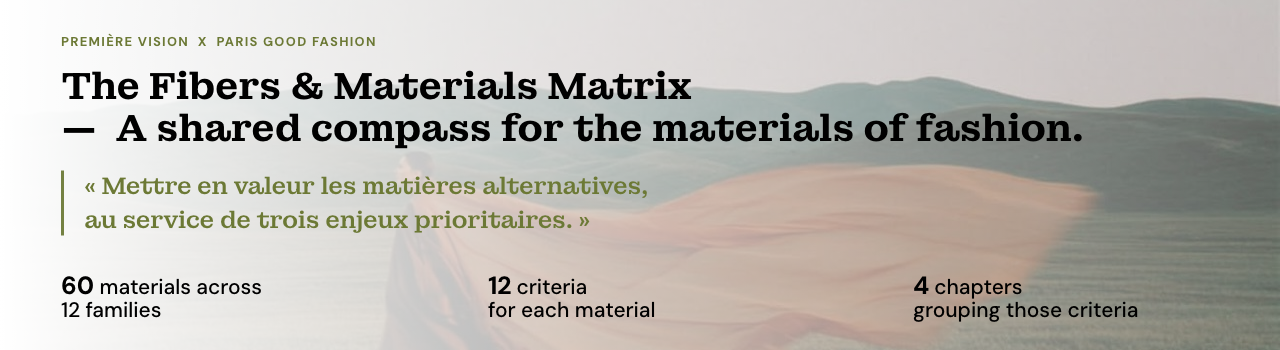
To go further, Première Vision is expanding its approach with the Fibres & Materials Matrix. A practical, concrete tool developed in partnership with Paris Good Fashion. Designed to guide your sourcing. A shared compass for fashion materials, created to help you better understand the alternatives and navigate an increasingly complex landscape..
The five complementary themes of the ‘a better way’ programme:
| 1 | Social initiatives | Decent, safe and fair working conditions |
| 2 | Impact of production sites | Environmental management, energy, water, waste |
| 3 | Traceability | Full traceability of material origins |
| 4 | Product composition & processes | Certified materials, controlled chemical management, animal welfare |
| 5 | Product cycle and end of life | Circularity, recyclability, physical durability, reuse |
THEME 1 – Social initiatives
 |
THEME PURPOSE
A company’s social responsibility is also measured by the working conditions it guarantees, both for its own employees and those of its subcontractors. This theme highlights the initiatives implemented in the areas of occupational health and safety, fair pay and the certification of social practices.
EXHIBITOR INITIATIVES
1/ Does the partner have an occupational health and safety policy in place?
Identify companies that implement risk prevention and occupational health and safety policies in accordance with national and international standards.
2/ How does the company contribute to fairer working conditions?
Discover companies committed to providing wages that enable workers to meet their essential needs, beyond local legal minimum wages where relevant.
3/ Are these commitments verified through certifications?
Identify companies whose social practices are certified against recognised standards such as SA8000, ISO 45001 or equivalent certifications.
| Questions to ask your supplier
- How do you assess social risks among your subcontractors? - How do you ensure that your social requirements are respected throughout your value chain? - How do you address the issue of a living wage? - What indicators do you use to measure your progress on social issues? - Can you share a concrete example of a recent improvement in working conditions? |
THEME 2 – Impact of production sites
 |
THEME PURPOSE
A company’s environmental impact is also measured by how it manages its production sites, whether in-house or subcontracted. This theme highlights the initiatives implemented in the areas of environmental management, energy, water management and waste management.
EXHIBITOR INITIATIVES
1/ Are you looking for companies committed to environmental management across their production sites?
Identify partners that rely on a certified environmental management system, such as ISO 14001, EMAS, LWG or an equivalent standard, to support the continuous improvement of their production sites.
2/ Are you looking for manufacturers that integrate renewable energy into their production?
Discover companies that manage their energy supply so that their sites are powered, in whole or in part, by renewable energy generated on-site or purchased from external sources.
3/ Are you looking for partners that manage their water consumption and waste?
Identify companies that implement solutions to treat and reuse wastewater, along with a structured approach to reducing, recovering and managing waste generated by their production activities.
| Questions to ask your supplier - What proportion of the energy consumed at your sites comes from renewable sources? - What proportion of the water used in your production facilities is currently reused? - How do you treat and recover the waste and by-products generated by your activities? - How do you monitor the environmental performance of your subcontracted production sites? - Can you share a concrete example of a recent reduction in the environmental impact of one of your sites? |
THEME 3 – Traceability
 |
THEME PURPOSE
Traceability provides a better understanding of product origins and their value chains. This theme highlights the initiatives implemented by companies to identify their suppliers, document the origin of their raw materials and better anticipate the associated social and environmental risks.
EXHIBITOR INITIATIVES
1/ Are you looking for partners with in-depth knowledge of their supply chain?
Identify companies that have mapped their Tier 1 suppliers and integrate social and environmental criteria into the monitoring of their partners.
2/ Are you looking for greater visibility into the origin of raw materials?
Discover companies that document their Tier 2 suppliers as well as the geographical origin of their strategic raw materials in order to strengthen product traceability.
3/ Are you looking for partners capable of anticipating risks across their value chain?
Identify companies that conduct risk assessments covering their strategic raw materials, sourcing regions and the associated social and environmental issues.
| Questions to ask your supplier
- Are you able to trace your main raw materials back to the producer or site of origin? - How do you document and update your supply chain mapping? - How do you verify the traceability information provided by your suppliers? - What measures do you take when a social or environmental risk is identified? - What traceability information are you able to share with your customers? |
THEME 4 – Composition of products & processes
 |
THEME PURPOSE
Product composition and manufacturing processes play an essential role in reducing environmental impact. This theme highlights the initiatives implemented by companies in terms of material selection, chemical substance management and commitments to animal welfare.EXHIBITOR INITIATIVES
1/ Are you looking for collections incorporating certified or recycled materials?
Identify companies that develop products certified according to recognised standards such as GOTS, GRS, RWS, FSC or LWG, and that incorporate a significant proportion of recycled materials into their collections.
2/ Are you looking for partners committed to managing chemical substances?
Discover companies that ensure their products comply with the REACH Regulation and, where relevant, rely on certifications or standards such as OEKO-TEX® Standard 100, EU Ecolabel, RSL, MRSL, or metal-free tanning for leather.
3/ Are you looking for lower-impact materials or supply chains committed to animal welfare?
Identify companies that incorporate alternative, bio-based or co-product-derived materials, and that formalise commitments to animal welfare, particularly on issues such as the Five Freedoms of animal welfare or the absence of mulesing.
| Questions to ask your supplier
- Do your certifications cover your entire production or only certain products? - How do you verify and document the recycled material content of your products? - How do you control the chemical substances used by your suppliers and subcontractors? - What criteria do you use to assess the alternative or bio-based materials you develop? - How do you verify compliance with your animal welfare commitments throughout your supply chain? |
THEME 5 – Product life cycle & end of life
 |
THEME PURPOSE
A product’s durability is considered from the design stage through to the end of its life. This theme highlights the initiatives implemented by companies to improve product recyclability, ensure durability, encourage the reuse of materials and limit excess stock.
EXHIBITOR INITIATIVES
1/ Are you looking for products designed to be more easily recyclable?
Identify companies that design their products to facilitate recyclability, particularly by favouring mono-material compositions, limiting certain fibre blends or, for leather, selecting tanning and finishing processes suited to end-of-life considerations.
2/ Are you looking for products designed to last?
Discover companies that carry out physical and mechanical tests to assess product resistance, colourfastness, wash performance and overall durability.
3/ Are you looking for partners committed to circularity?
Identify companies that develop initiatives to reuse deadstock materials, recover production offcuts or produce on demand in order to limit waste, the use of virgin resources and excess stock.
| Questions to ask your supplier
- What design choices do you make to facilitate the recycling of your products? - What tests do you carry out to assess their durability over time? - What proportion of your production offcuts is currently reused, recycled or recovered? - How do you adapt your production volumes to limit excess stock? - What solutions have you developed to extend the lifespan of your products or facilitate their end of life? |
 |
| BROWSE THE MATRIX (coming soon) |