The long term is emerging as a new source of value. This new analysis extends the exploration of the AW 27-28 season by taking a deeper look at one of its three key scenarios: Matter of Time. Through weak signals spotted in contemporary art, culture, luxury and beauty, this theme highlights the emotional and creative value of what is resisting contemporary immediacy. Classical references, complex savoir-faire and altered beauties are all pointing to the same dynamic: the renewed desirability of what carries memory, presence and duration.
Classical Resonances and Contemporary Art
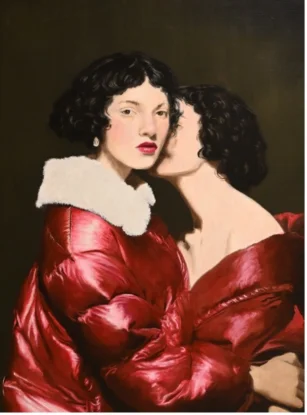
Numerous exhibitions in New York, London and Paris are currently highlighting the dialogue between ultra-contemporary artists and classical references from European art history. Artists such as Émile Brunet and Nieves González, as well as the “Clair-Obscur” exhibition at the Bourse de Commerce in Paris, featuring works by Victor Man, are illustrating this return to pictorial forms steeped in memory and depth.
These anchors in the past recall the lasting power of classical art. They also express a need for denser, more embodied and more universal visual landmarks that are capable of withstanding the relentless flow of images being generated and consumed continuously.
Title of work: CARNALE / Artist: Nieves González / Medium: Oil on canvas / Dimensions: 81 X 61 cm / Year: 2025 / Photography credit: Courtesy of the artist
The Human as Proof of Value
This search for depth is echoed in the way in which the human touch is once again becoming a marker of distinction. Not By AI, Proudly Human, TikTok Author: several initiatives are emerging simultaneously to make the human origin of a creation visible, or even to prove it in real time through live creation formats.
This proliferation is no coincidence. It echoes the “dead internet theory”, the idea of a web increasingly populated by automated content. In this context, making, showing that one is making, and proving the human origin of a creation are becoming sources of value. The human touch is no longer merely an invisible process; it is becoming a signature, a guarantee, almost an emotional certification.
Mastery, Complication and Savoir-Faire
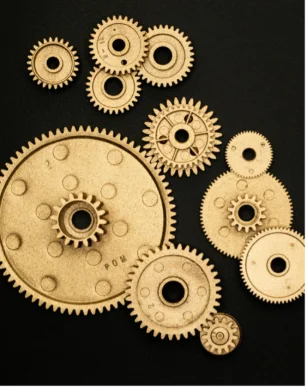
In the luxury sector, this growing appreciation for the long view is also expressed through technical mastery. The watchmaking house Vacheron Constantin is pushing the art of mechanical complication to its extreme, with an array of 63 interconnected functions: moon phases, the equation of time, a minute repeater and a perpetual calendar.
Beyond performance, it is the very idea of invested time that is becoming precious. Complexity, patience, the precision of the gesture and the requirements of savoir-faire remind us that an object’s value can also be measured by what it has taken to create it.
Heritage, the Sacred and Dark Romanticism
Contemporary culture is also reactivating historical, religious and Gothic references. Rosalía’s universe for Lux sees the divine, traditional musical forms such as modal singing and ancient rhythms, and a tour conceived as a total work all come together. The artist is inviting us to slow down, to accept density, and to enter a more symbolic, more inhabited world.
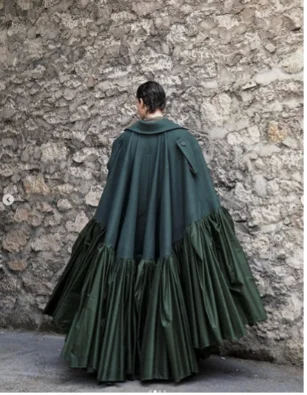
In cinema and literature, the return of the Gothic has confirmed this same attraction to narratives steeped in shadow, desire and memory, with films such as the highly publicized return of Wuthering Heights starring Margot Robbie and Jacob Elordi, or Dracula revisited by Luc Besson. Ruins, capes, darkness, tragic passions and Romantic archetypes are no longer merely historical references. They are becoming powerful emotional structures, capable of imbuing the present with a new intensity.
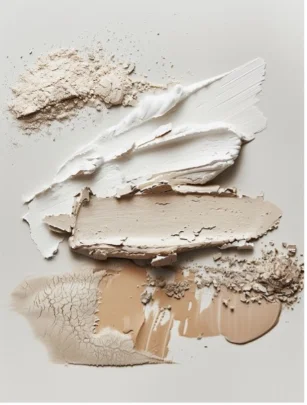
This appreciation of time, gesture and memory is finding a direct expression in material and beauty aesthetics. Autumn-Winter 27-28 is exploring an approach in which dirt, patina, creasing or rubbed effects are no longer perceived as alteration, but rather as the manifestation of a physical presence.
In fragrance, this logic is embodied in the appeal of animalic, musky signatures. In beauty, textures are appearing smudged, creased, rubbed. Pigments are shifting, finishes are becoming blurred. The palette combines chalky tones, earthy beiges and cool desaturated shades, reinforcing the impression of a body marked and traversed by material.
These clues are pointing to a shared dynamic for Autumn-Winter 27-28: the desire to reconnect with slower, more embodied forms, endowed with substance and capable of conveying a narrative.