
Masters of leavers laces and embroideries at Première Vision Paris
While the immateriality and potentials of AI start to grow issues on trust, and with it, the differentiation of fake and true being harder and harder to perceive, the appeal and interest for physicality, for touch, for tactile realities and hand made craftmanship, and thus the value of very unique 'Savoir-Faire', that no machine (yet) can replace, is growing. And the splendour of one of the oldest French know-how’s, the Calais/Caudry leavers lace, as much as specific haute couture embroidery techniques are shining even brighter under this light.
Crafting elegance: France’s Leavers lace & embroidery know-how
In the heart of northern France, a centuries-old textile legacy continues to thrive. Caudry and nearby Calais, once bustling with tens of thousands of lace workers at the Belle Époque peak, still hold the world’s premier Leavers lace and haute couture embroidery savoir-faire. Today these towns may be home to only half a dozen lace-making firms, yet that compact cluster supplies the top international lingerie and corsetry brands, as well as haute couture and luxury ready-to-wear houses.
Indeed, roughly 75% of the world’s Leavers lace production comes from Caudry’s basin, and a staggering 90% of the remaining Leavers looms on earth are concentrated in Calais/Caudry.
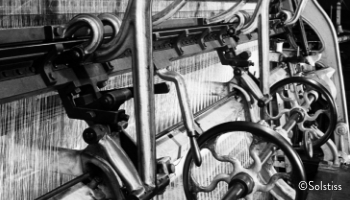
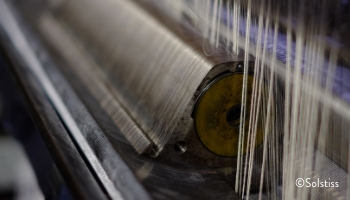
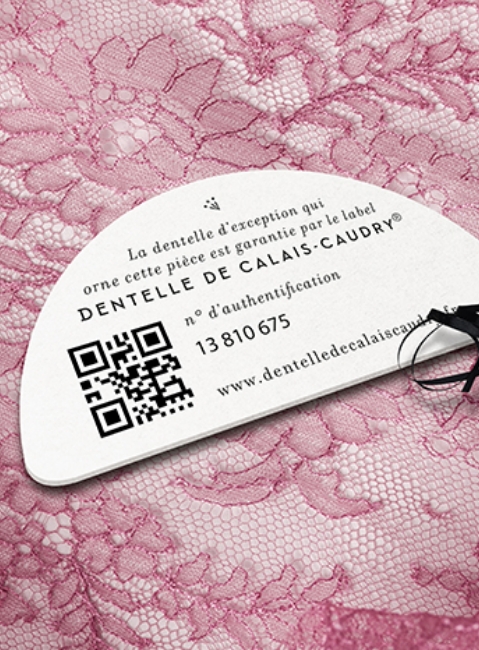 | This unique industry is safeguarded by the Dentelle de Calais-Caudry® label, a seal of French excellence that certifies lace is woven here using “traditional, two-hundred-year-old skills”. In practice, this means that every motif and tulle is created by the iconic Leavers loom – a six-meter, cast-iron, integrating a complex Jacquard-equipped machine that “is the only machine capable of perfectly imitating the agile hands of manual lacemakers”. And it does nevertheless involve a lot of manual work, 85% of its steps are hand made, and expert artisans still oversee every step: from drawing designs and warping thousands of threads, to carefully inserting bobbins and tending the slow-moving 2-meter-per-hour loom. The result is a fabric whose finesse, transparency and refinement rival handmade lace, carrying a luxurious depth and subtlety only generations of mastery can produce. |
“It is an artistic craftmanship, at the scale of industrial production.”
Adeline Sapin, Artistic Director - Solstiss
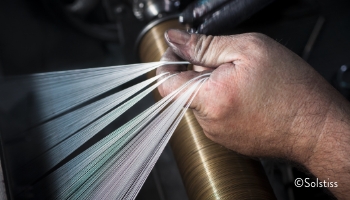
The essence of leavers lace, lying in it the delicacy, has to be well understood: It is a weaving technique, and has not to be confused with Raschel Lace, which is a knitted, quicker to produce version. Leavers laces does create micro – architectures alike, imitating at perfection the handmade artisanal lacework from the 18th and 19th century. And if the machines seem old to us, (they are indeed more than 200 year old!) up to now, no other machine can rival with the beauty of these leavers laces. While designing the laces remains the most time-consuming stage of lace production, the most intricate and delicate task is threading the loom. Thousands of individual threads (over 15,000 !) feed into the machine; the greater the design complexity, the more threads are required, which in turn increases the cost of the final lace.
Masters of french lace, still innovating day by day
Several historic ateliers keep this delicate craft alive. Dentelle Beauvillain-Davoine, a family firm founded in 1902, perpetuates the tradition of Leavers lace in Caudry. Under this philosophy, Beauvillain-Davoine creates exceptional laces for haute couture, bridal and luxury lingerie, distinguished by delicate floral motifs and an almost ethereal drape.
| Similarly, Solstiss, whose machines date back to the late 19th century, merged in 1974 five historic lace houses. Solstiss’s fine luxury laces are known for their contemporary designs, in an infinite variety of motifs and colours, enriched by high-end artisanal embroidery, unique quality and both technical and aesthetic innovations. Their Dentelle Sophie Hallette is another marquee name. Based in Caudry, the House of Sophie Hallette has inspired couture and luxury labels worldwide. Since 1887 it has woven bobbinet tulle and Leavers lace that pay homage to light and transparency, continually remodeling its interlacings with new patterns, colours or subtle ornamentation. | 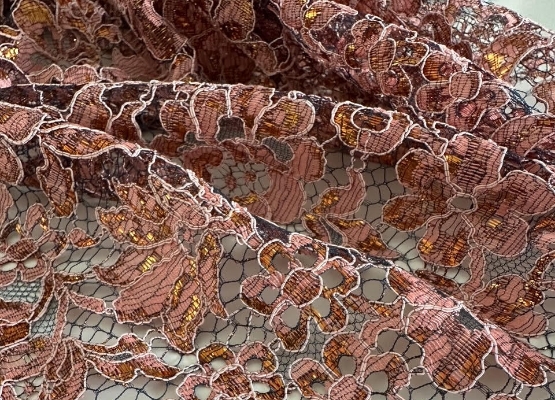 ©Solstiss |
Jean Bracq, a Caudry workshop now in its fifth generation, blends heritage and renewal: in 2012 it even acquired the three last remaining Lyon lace looms from Goutarel to keep that history alive. The company’s site celebrates that Jean Bracq lace “is the result of a long family tradition and the transmission of a unique know-how,” used by haute couture and fine ready-to-wear houses, and continuously keeping track of today’s rapidly evolving trends.
These houses hold France’s Entreprise du Patrimoine Vivant (EPV) label, a government mark of craftsmanship excellence, that actively trains new generations of lacemakers to preserve this living heritage.
 |  |  |  |
All pictures ©Solstiss
French embroidery: tradition and innovation
Embroidery in France has a similarly rich story. Lyon was long famed for its silk embroideries and points de fantaisie, and today those techniques coexist with computerized embroidery and experimental design. Maison Lévêque exemplifies the best of couture embroidery. It manufactures, designs and markets various embroidery exceptions, intended for haute couture, bridal dresses, lingerie, linens and even furniture. In practice, Lévêque’s artisans adorn fabrics with sequins, pearls, metallic threads and other flourishes – transforming lace, tulle or mesh into elaborate, dimensional textiles. The atelier is known for fast, flexible production schedules to meet any designer’s deadline.
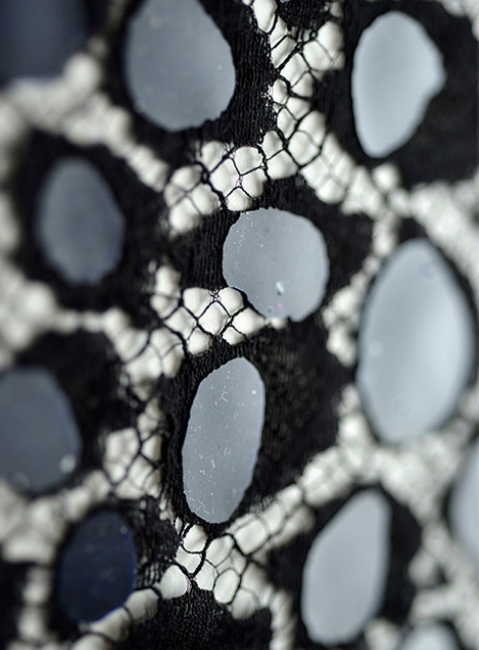
Albert Guegain & Fils is another embroidery house that bridges tradition and creativity. Its story goes back to 1888, when the first Cornely embroidery machines arrived in Liévin (Pas-de-Calais); Albert Guégain himself founded the company in 1954.Today the firm has developed a strong know-how in various sectors of embroidery. Its newest collections show a daring inventiveness – bold motifs on sheer grounds, playful contrasts of scale and subtle sheens from mixed yarns – all reflecting an heritage of innovation.
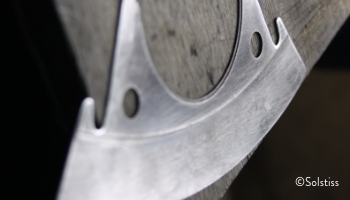
 | In terms of sustainability, most of the houses are doing their best to respond to the growing regulatory demands. While REACH has been a huge challenge that has reshaped a lot of things from the inside, and is now truly integrated, the demands from brands, requesting a rapid transformation, less impactful yarns, and of course Data, while expecting no cost rise and no speed loss, are of real concern for the mills. While no one is denying the need to shift, evolve and transform – these adjustments are often of a complexity that often only insiders do understand. If you have to replace one yarn in the laces, you need to completely change the bobbins (the small disks that lead each single yarn…), which is very costly and time consuming, if not impossible to be done since, as of today, the manufacturing of these bobbins is probably close to non-existent. |
Nevertheless, all of the French companies cited are investing to be able to respond to sustainability requirements, and their agility lies in their flexibility and openness to sometimes share their pieces, to answer to the demands. One must applaud and support the cost of such investments.
Craftsmanship on display at Première Vision
Paris Première Vision provides a rare opportunity to meet these artisans. In today’s world of fast fashion, such encounters with centuries-old know-how feel truly special, and are a key differentiation. This is where the true value of fashion lies, in the invisible and “down-to-earth” technical knowledge, that has to be brought into light and preserved.
| On the lace side, Beauvillain-Davoine, Solstiss, Sophie Hallette and Jean Bracq will exhibit their latest creations. One stand might feature meter-long panels of embroidered Chantilly lace in warm neutrals, the next a showcase of richly beaded Guipure or rebrodé appliqués. Buyers and designers can touch samples of jeweled tulle and ask about processes like traditional point de Lunéville or new digital jacquard finishes. Meanwhile, embroidery studios like Maison Lévêque and Albert Guégain & Fils will present sumptuous samples on tulle, mesh and fine net. Lévêque’s booth might include sparkling sequin-and-pearl patterns or floral appliqués on stretch tulle, while Albert Guegain’s team could showcase their latest development of a Cornely machine. | 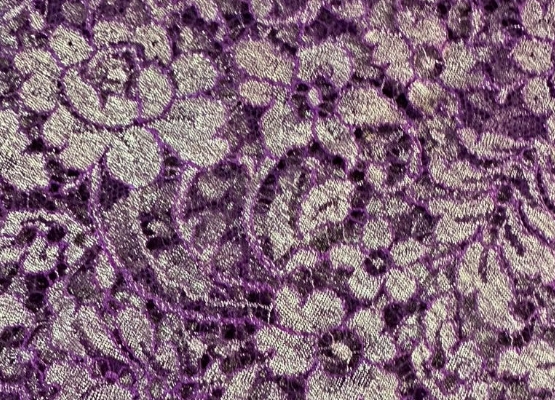 ©Solstiss |
And, in the end, French Leavers lace and embroidery remain as much about people as about machines. The tapestry of stories, of family businesses, of apprenticeships passed down, of “a perfect balance of machine and man”, is what gives these textiles their soul. Each lace border and every embroidered motif carries decades of accumulated skill. By visiting the stands, (or simply touring the Première Vision forums), one learns why a simple fabric can feel like a piece of living history. The next time your eye is caught by a floaty lace or a detailed embroidered textile, remember that behind its beauty stands the craftsmanship of France’s finest lacemakers and embroiders, ready to be discovered.
 |  |